July 11: International Day of Reflection and Commemoration of the 1995 Genocide in Srebrenica.
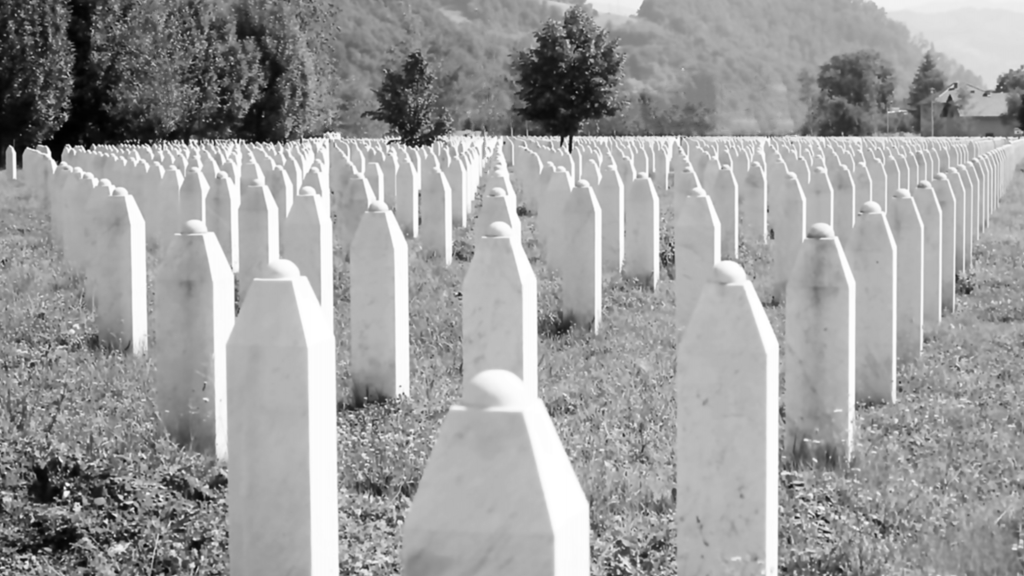
The Genocide in Srebrenica
As early as April 1992, the armed forces of the Republika Srpska and the Yugoslav People’s Army (JNA) launched targeted military operations in what is now eastern Bosnia, primarily in predominantly Bosniak towns and villages. These operations involved systematic persecution, murder, and displacement of the Bosniak civilian population in the Drina Valley.
Throughout the war, the city of Srebrenica was under constant shelling by Bosnian Serb forces. The city suffered severe supply shortages and a humanitarian crisis, which were deliberately created in order to starve the population. In 1993, the United Nations declared Srebrenica a “safe area.” Many civilians sought refuge there, hoping for protection and safety.
In the spring of 1995, Radovan Karadžić ordered a systematic strategy to expel or annihilate the Bosniak population of Srebrenica. In July 1995, the UN-protected area fell into the hands of the Bosnian Serb troops. More than 8,372 Bosniak men and boys were systematically executed, women and children were deported, and countless individuals were tortured and abused.
This genocide occurred despite the presence of UN peacekeeping forces and under the eyes of the international community. The late and inadequate intervention by global actors drew sharp criticism. Srebrenica became a symbol of the UN’s and the international community’s failure to protect human life.
In an effort to cover up the crimes, the Bosnian Serb army (VRS) attempted to destroy evidence by digging up primary mass graves and reburying the remains in secondary and tertiary graves. Human remains were often discovered scattered and fragmented. This systematic concealment was intended to hinder investigation and prosecution.
The courageous struggle of the Mothers of Srebrenica played a crucial role in achieving international recognition of the genocide. Many of them fought tirelessly for justice and remembrance, often while enduring deep personal pain. Tragically, many died without ever recovering the remains of their sons, husbands, or brothers. Their efforts remain a powerful symbol of resistance against forgetting and a plea for the acknowledgment of the victims’ suffering.
In 2024, the United Nations adopted a resolution officially declaring July 11 as the International Day of Remembrance for the Genocide in Srebrenica.
Legal Accountability
The International Criminal Tribunal for the former Yugoslavia (ICTY) in The Hague convicted several top military and political leaders for the genocide in Srebrenica. The tribunal confirmed that the killings were premeditated and systematically carried out with the aim of eradicating the Muslim population of the region. The rulings also emphasized the deliberate deception and failure of the international community, especially the United Nations, which had peacekeeping troops on the ground but did not intervene.
Among those convicted were Ratko Mladić, the then-commander of the Bosnian Serb forces, and Radovan Karadžić, the political leader of Republika Srpska. Both were sentenced to life imprisonment. These rulings are landmark decisions that recognize the responsibility for genocide and war crimes at the highest levels and send a vital message about international justice and the prevention of future genocides.
The Srebrenica Flower
As a symbol of remembrance and mourning, the so-called Srebrenica Flower (“Cvijet Srebrenice”) has become widely recognized. It represents the suffering of the victims, but also embodies hope and the will to keep their memory alive.
The flower is designed in white and green:
White symbolizes the innocence of the victims, while green stands for hope and new life.
Its eleven petals represent July 11, the International Day of Remembrance and the date on which the genocide began.
Today, the Srebrenica Flower is a globally acknowledged symbol against forgetting. It is worn as a sign of mourning, remembrance, and a collective commitment to say “Never Again.”